


U.S. Saw Record New Clean Power Capacity Last Year in Spite of Delays, Cancellations
(Washington, D.C. – March 17, 2026) A new report finds that the U.S. saw a record amount of new clean power capacity come online last year – but also saw significant project cancellations and delays, in part due to hostile federal government policies, that kept the sector from fulfilling its potential at a time when the country is facing rapidly growing demands for new and affordable power.
“Clean energy sources like wind, solar and batteries are dominating new additions to the grid because they are the most affordable sources of energy and relatively quick to build,” said Grace Hauser, technical analyst for Environmental Defense Fund. “This is why the Trump administration’s efforts to block clean energy projects and mandate the use of costly, polluting fossil power plants go against the market -- and burden families with higher costs and more air pollution. At a time when energy demands and people’s power bills are both skyrocketing, we need all the clean, affordable energy we can get.”
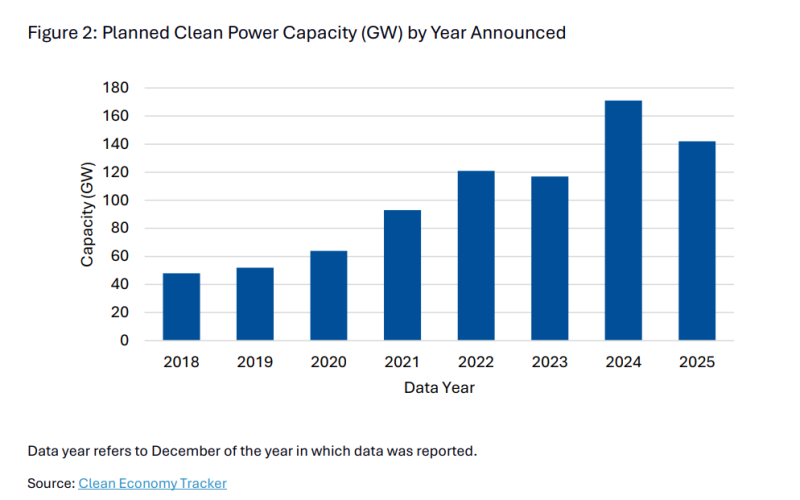
The report, by Environmental Defense Fund and Atlas Public Policy, is the latest in a series. Among its key findings:
- The U.S. saw a record 48.5 gigawatts of new clean power capacity come online in 2025.
- That’s the equivalent of about 23 Hoover Dams.
- More than four times as much clean power capacity – 217 gigawatts – is now either planned or under construction. (That’s also almost five times as much as the fossil fuel capacity that’s planned or under construction in the U.S.).
However:
- Earlier in 2025, more than 60 gigawatts of new clean energy capacity had been expected to come online. More than 20% of that planned capacity did not materialize because projects were delayed.
- Some of those delayed projects could come online in 2026. For instance, Vineyard Wind – an offshore wind project that the Trump administration had tried to cancel – announced that its construction was completed just days ago.
- Another 13 gigawatts of previously planned clean energy capacity was cancelled in 2025.
The report points out that demand for electricity in the United States is set to grow twice as fast over the next five years as it did in the previous decade, and that 2025 showed “continued growth in new clean power capacity despite increasing challenges due to new federal policy.”
“Power demand and electricity rates are both expected to rise in coming years, increasing pressure on policymakers to keep electricity affordable. The growth [in clean energy capacity] comes amidst significant hostility from the federal government toward wind and solar power, including Department of Interior restrictions, cancellations of large projects, Congressional cuts and revisions to tax credits primarily for clean energy production investment and, in Q4 2025, Department of Energy (DOE) cuts to grant programs that support clean energy deployment.” (Report, Page 4)
Those hostile policies are most likely to hurt Republican-led states and districts:
- 80% of the existing, under construction, and planned clean energy capacity in the U.S. is in House districts represented by Republicans.
- Of the 30 districts with the highest clean energy capacity, 27 are represented by Republicans.
- Texas leads all states for clean power capacity, with more than double the existing clean power capacity of California.
- Texas is also the state hit hardest by clean project cancellations. The state lost 5.7 gigawatts of planned clean power capacity in 2025 – including 2.7 gigawatts in Q4 alone.
- Maryland, Nebraska, North Dakota, and Idaho had the largest proportions of canceled clean energy capacity in 2025 as a percentage of planned and under construction clean capacity.
You can read the entire report here, and find earlier EDF and Atlas Public Policy reports on clean energy and clean manufacturing here.
With more than 3 million members, Environmental Defense Fund creates transformational solutions to the most serious environmental problems. To do so, EDF links science, economics, law, and innovative private-sector partnerships to turn solutions into action. edf.org
Related Expert

Technical Analyst, Clean Power
Latest press releases
-
Statement: Momentum for broad Western electricity market that delivers clean, affordable power grows with new commitment from Montana utility
August 10, 2026 -
Senate farm bill stalls, leaving farmers in limbo
August 6, 2026 -
Court blocks Trump administration’s freeze on affordable wind energy
August 6, 2026 -
Trump administration’s latest wasteful buyout shrinks California offshore wind industry to just two leases
August 6, 2026 -
EDF expert testimony finds Entergy has failed to justify its proposed $4.1 billion investment in two new Louisiana gas plants
August 6, 2026 -
New York strengthens regulations to cut pollution from power plants and invest in clean, affordable energy
August 5, 2026