


Launch of new Western electricity market will curb costs, boost reliability and cut pollution as surging demand strains the grid
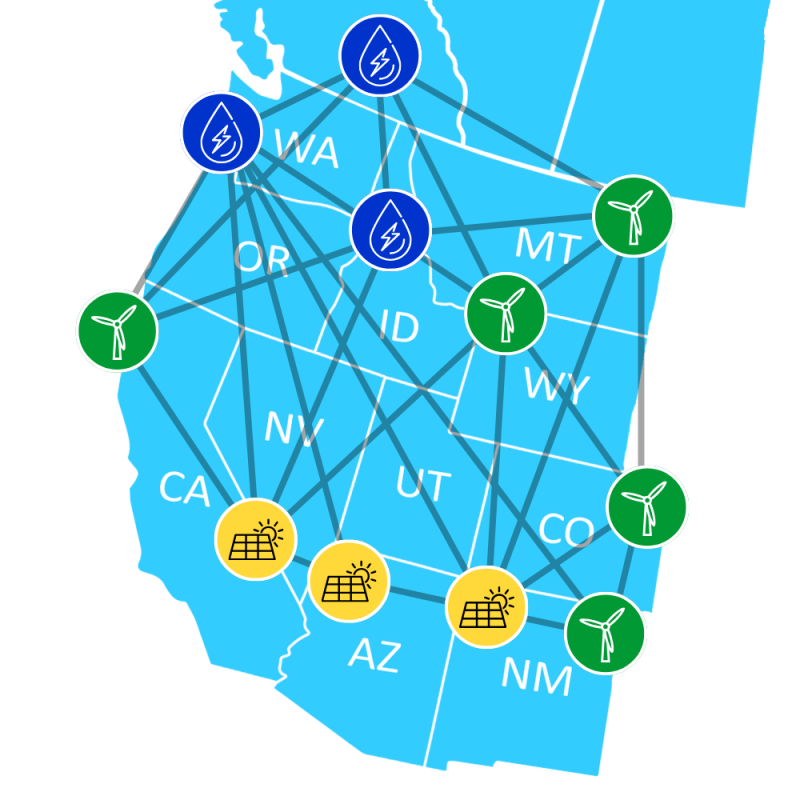
Studies consistently show that a large, unified Western market delivers the most savings for ratepayers by unlocking greater access to clean energy
SAN FRANCISCO — A new Western power market, known as the Extended Day-Ahead Market, officially began operations today, marking a new era for electric power coordination in the Western U.S. The market will allow utilities to optimize the sharing of electricity across the region on a day ahead timeframe — cutting costs and boosting reliability as soaring power demand from data centers and industry, as well as extreme weather events like heat waves put tremendous pressure on the grid.
Broader access to the West’s vast energy resources will lower electricity bills by unlocking more affordable clean energy and offsetting the need to run and build local, costlier fossil fuel power plants. Studies find that utilities across 11 states in the West would save over $1.2 billion a year under a West-wide market and reduce climate pollution from the region by 39% by 2032.
“The West is rich with a diverse mix of renewable resources, and this market will capture their potential,” said Michael Colvin, Director, California Energy Program at Environmental Defense Fund. “Through better sharing of cheap, clean energy beyond state borders, the market will cut household bills, reduce reliance on expensive, polluting fossil plants and build a grid that's bigger than any single extreme weather event.”
The West already operates a real-time electricity market where electricity is traded immediately; however, it is one of the few regions in the U.S. without a coordinated system to buy and sell power from utilities across the region a day in advance. Instead, 38 local grid managers rely on a patchwork of bilateral agreements — a fragmented approach that makes it hard to move the lowest-cost power efficiently from where it’s generated to where it’s needed.
At launch, the Extended Day-Ahead Market participants include PacifCorp, Pacific Gas & Electric, Southern California Edison and San Diego Gas & Electric, with more participants on the way. The market will be governed by a soon-to-be formed independent Regional Organization for Western Energy, the result of legislation in California that transferred governance from its grid operator to an independent organization that will represent the West. Another competing day-ahead market — called Markets+ — run by Southwest Power Pool in Arkansas, started last month and is also signing up Western grid managers and utilities. The market that utilities and local grid managers ultimately join will have major consequences for electricity costs, grid reliability and clean energy development across the West.
“The bigger the market, the bigger the savings — that’s why this market decision matters enormously,” said Alex DeGolia, Director, State Legislative and Regulatory Affairs at EDF. “Utilities and state leaders should carefully evaluate which market will tap the most cost-savings and is best equipped to keep the lights on. At a time when families are being stretched thin by energy costs, leaving money on the table should not be an option.”
Multiple studies reinforce that when the grid works as one large market instead of multiple smaller ones — as the West is currently headed toward — utilities can buy lower-cost power more often and more efficiently route power to communities that need it most.
- Arizona: All of Arizona’s three major utilities have indicated their preference for Markets+. If they participated in EDAM, the state could see $114 million in annual savings, which could offset recent and pending rate hikes.
- Colorado: Xcel Energy Colorado has also committed to Markets+. If it participated in EDAM, it would reduce costs on average by $13.2 million annually.
- California: All of California’s major utilities are joining EDAM. A single, unified EDAM market across the West would result in approximately $350 million in average annual cost-savings for California, compared to a split market scenario.
For more background on the Western electricity market, this EDF blog explains further: Western electricity markets: Going further, together
With more than 3 million members, Environmental Defense Fund creates transformational solutions to the most serious environmental problems. To do so, EDF links science, economics, law, and innovative private-sector partnerships to turn solutions into action. edf.org
Related Expert

Director, Regulatory and Legislative Affairs

Senior Director, Clean Electricity
Latest press releases
-
Western electricity market appoints independent board, as momentum grows
September 25, 2026 -
Arizona Corporation Commissioner requests review of utilities’ billion-dollar electricity market decisions
September 24, 2026 -
Governor Newsom announces major step toward the linkage of California and Washington state Cap-and-Invest programs
September 23, 2026 -
Coming soon: Trump administration poised to weaken national methane protections
September 23, 2026 -
EDF, IUCN and IWMI call for accelerating action on the global groundwater crisis ahead of the UN Water Conference
September 23, 2026 -
New York Governor Hochul announces new steps to deliver affordable, reliable clean energy for New Yorkers
September 22, 2026